DevSecOps as a Governance Architecture — Not a Toolchain
In regulated environments, DevSecOps is not a cultural slogan.
It is a control architecture.
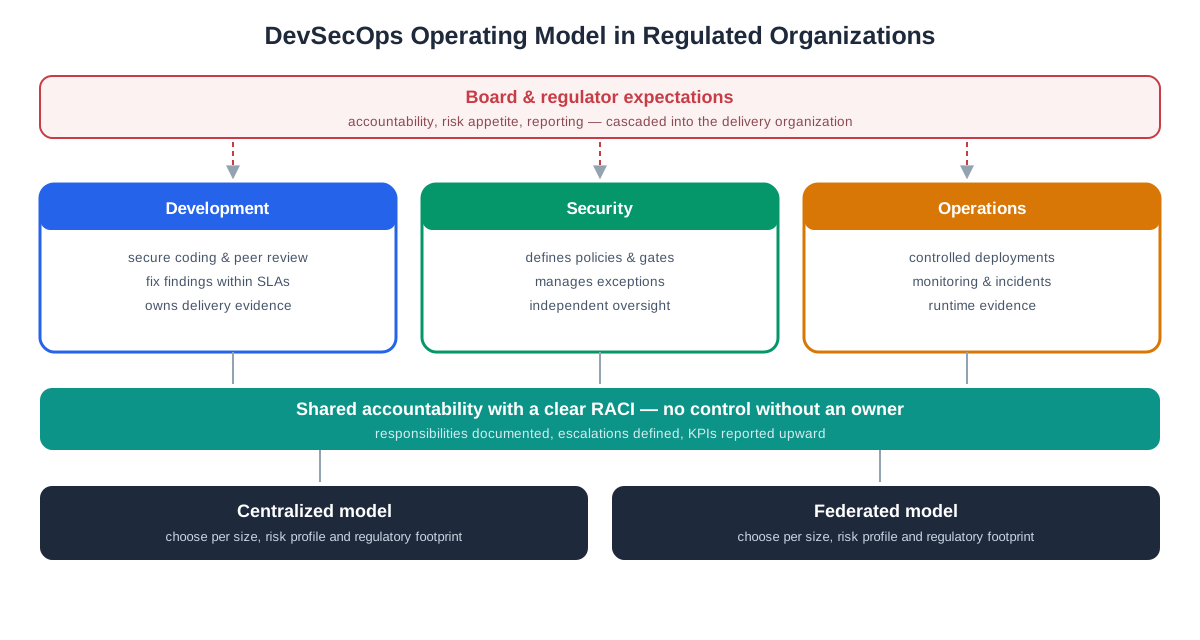
DevSecOps defines how:
- Security requirements are embedded into engineering workflows
- Responsibilities are separated and enforced
- Controls are automated and non-optional
- Evidence is generated as a by-product of normal operations
In banking, insurance, healthcare, public sector, and critical infrastructure, DevSecOps is what transforms delivery pipelines into regulated systems.
It is not about adding security tools.
It is about designing a delivery model where controls are enforced by default.
DevSecOps vs CI/CD Security vs Application Security
Security in regulated software delivery operates across three distinct domains:
CI/CD Security
Secures the delivery infrastructure.
Pipelines, approvals, artifact integrity, supply chain controls, audit logs.
Application Security
Secures what is being built.
Design, vulnerabilities, dependencies, runtime protection.
DevSecOps
Secures how work happens.
Governance, role separation, policy enforcement, and control integration across teams.
DevSecOps is the connective layer.
It ensures that CI/CD Security and Application Security controls are:
- Applied consistently
- Enforced automatically
- Governed centrally
- Auditable systematically
Without DevSecOps, controls remain fragmented and dependent on individual discipline.
DevSecOps as an Operating Model
In enterprise contexts, DevSecOps defines:
- Who can approve production changes
- Who can modify pipeline configurations
- Who can override security gates
- How exceptions are reviewed and documented
- Where evidence is stored and retained
It answers questions auditors always ask:
- Are duties properly segregated?
- Are changes approved?
- Are security checks mandatory?
- Can this be proven retroactively?
DevSecOps makes the answers systematic — not situational.
DevSecOps Under Regulatory Constraints
Regulated industries operate under strict expectations:
- Segregation of duties
- Controlled production access
- Traceable and approved changes
- Continuous monitoring
- Long-term evidence retention
DevSecOps embeds these constraints directly into engineering workflows.
Instead of slowing teams down with manual review layers, it:
- Automates enforcement
- Structures approvals
- Produces traceable logs
- Aligns engineering with compliance
This is how organizations scale securely.
Core DevSecOps Principles in Regulated Environments
Effective DevSecOps implementations rely on non-negotiable principles:
1. Security by Design
Controls are embedded at architecture level, not added later.
2. Automation of Enforcement
Manual review does not scale. Enforcement must be systemic.
3. Least Privilege & Segregation of Duties
Role separation is enforced technically, not by policy alone.
4. Policy-as-Code
Security and compliance rules are codified and versioned.
5. Evidence-by-Design
Logs, approvals, and control outcomes are generated automatically.
6. Continuous Feedback
Security signals influence planning and prioritization.
DevSecOps institutionalizes these principles.
DevSecOps Across the Secure SDLC
DevSecOps spans the entire lifecycle:
Developer Workflows
Commits • Pull requests • Reviews
Branch protection • SAST feedback • Secrets hygiene
CI/CD Enforcement
Policy gates • Approval workflows
SCA • SBOM • Artifact signing
Controlled overrides
Release & Deployment
Change management enforcement
Segregation of duties
Protected deploy paths
Runtime & Monitoring
Security monitoring
Incident response integration
Audit-ready logging
At each stage, controls are:
- Enforced automatically
- Logged systematically
- Correlated centrally
This creates a continuous control chain.
Why Auditors Care About DevSecOps
Auditors do not evaluate DevSecOps maturity frameworks.
They evaluate control reality.
They assess whether:
- Controls exist
- Controls are enforced
- Exceptions are governed
- Evidence is reliable
- Processes are repeatable
From an audit perspective, DevSecOps provides:
- Clear control ownership
- Consistent enforcement
- Traceable change management
- Reliable evidence generation
DevSecOps is what makes continuous compliance operationally feasible.
DevSecOps as a Continuous Compliance Engine
Traditional compliance models rely on periodic audits.
Regulated DevSecOps replaces this with:
- Continuous control enforcement
- Continuous logging
- Continuous traceability
- Continuous monitoring
When pipelines, roles, and workflows are structured correctly:
Compliance becomes a property of the system. Not a project.
See Continuous Compliance via CI/CD and Continuous Auditing vs Point-in-Time Audits.
DevSecOps and Enterprise Architecture
DevSecOps must align with:
- CI/CD enforcement architecture
- Application security tooling
- Identity & access governance
- Cloud platform controls
- Compliance frameworks (DORA, NIS2, ISO 27001, SOC 2, PCI DSS)
It does not replace these disciplines.
It integrates them.
Together, they form a coherent security architecture for regulated software delivery.
Common Misconceptions
❌ DevSecOps is just adding scanners to pipelines
No — that is tooling, not governance.
❌ DevSecOps removes the need for segregation of duties
No — it enforces it technically.
❌ DevSecOps is incompatible with strict compliance
No — it is what makes strict compliance scalable.
Executive View
For leadership, DevSecOps provides:
- Risk reduction through systemic enforcement
- Faster audits through structured evidence
- Clear accountability
- Scalable governance
For engineering, it provides:
- Predictable workflows
- Clear rules
- Automated enforcement
- Reduced friction
When implemented correctly, DevSecOps increases both delivery speed and regulatory confidence. See Executive Audit Briefing — CI/CD Pipelines in Regulated Environments.
DevSecOps Operating Models Deep Dives
Explore detailed guidance on building and assessing DevSecOps governance:
Governance & Accountability
- DevSecOps RACI Matrix for Regulated Organizations — Who is responsible, accountable, consulted, and informed for every DevSecOps activity
- DevSecOps Operating Models — Centralized vs Federated vs Hybrid — Which governance structure fits your regulatory context
- AppSec Governance Model — Roles, Responsibilities, and Oversight
Measurement & Maturity
- DevSecOps Program — Board-Level Reporting and KPIs — Translating DevSecOps metrics into executive language
- DevSecOps Maturity Assessment Framework — Structured self-assessment across 10 dimensions
- Application Security Metrics That Auditors Can Trust
Audit & Evidence
- How Auditors Actually Review CI/CD Pipelines
- Building an Evidence Repository for Continuous Compliance
- Common Audit Findings — Top 10 CI/CD Failures
Related Domains
| Domain | Focus | Hub |
|---|---|---|
| CI/CD Governance | Pipeline controls, enforcement, access | Explore |
| Application Security | Code-level controls, SDLC governance | Explore |
| Architecture | Enforcement models, system design | Explore |
| Regulatory Frameworks | DORA, NIS2, ISO 27001, SOC 2, PCI DSS | Explore |
| Audit & Governance | Evidence validation, assessment | Explore |
Final Perspective
DevSecOps is not about culture alone. It is about control architecture.
In regulated environments, DevSecOps transforms software delivery from a workflow into a regulated system — one that delivers rapidly, maintains strict governance, produces audit-ready evidence, and demonstrates operational resilience.
Related for Auditors
- Glossary — Plain-language definitions of technical terms
- Before the Auditor Arrives — CI/CD Readiness Checklist
- Executive Audit Briefing
- Full Resource Directory
New to CI/CD auditing? Start with our Auditor’s Guide.


