DevSecOps & CI/CD Security for Regulated Industries
Engineering Security That Auditors Can Verify
Authoritative guidance for auditors, compliance officers, and risk managers on:
- CI/CD governance and pipeline controls
- Regulatory compliance (DORA, NIS2, ISO 27001, SOC 2, PCI DSS)
- Audit readiness and evidence frameworks
- DevSecOps operating models for regulated industries
Designed for regulated environments such as:
Banking • Insurance • Public Sector • Critical Infrastructure • Healthcare
In regulated contexts, security is not just about reducing risk.
It is about enforcing controls and producing audit-ready evidence by design.
New to CI/CD Auditing?
If you are an auditor, compliance officer, or risk manager encountering CI/CD pipelines for the first time, start here:
- Start Here — Auditor’s Guide to CI/CD Security — A structured introduction to the key concepts, controls, and terminology you need.
- Glossary of CI/CD and DevSecOps Terms — Plain-language definitions of technical terms used throughout this site.
Content Pillars
Each section on this site addresses a distinct domain within regulated software delivery:
- Regulatory Frameworks — DORA, NIS2, ISO 27001, SOC 2, PCI DSS. Article-level analysis, controls mappings, and compliance architecture for each regulation.
- Audit & Evidence — Auditor checklists, evidence packs, verification guides, and audit-day preparation resources.
- CI/CD Governance — Pipeline controls, enforcement models, security architecture, and CI/CD as a regulated ICT system.
- DevSecOps Operating Models — RACI matrices, governance structures, maturity frameworks, and organizational design for security.
Coverage by Regulation
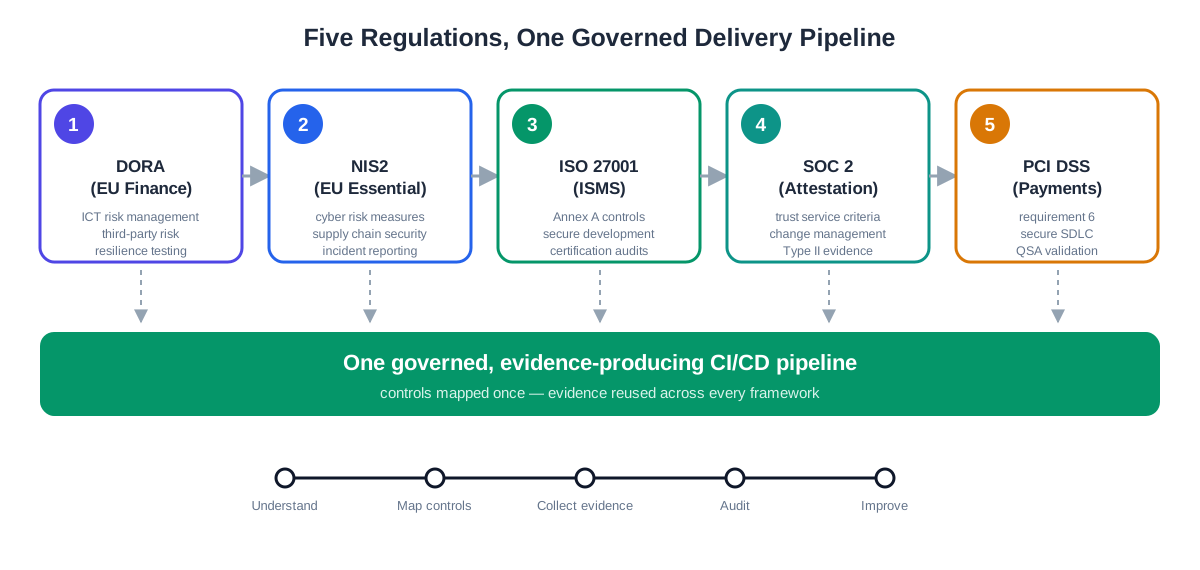
This site provides in-depth coverage of five major regulatory frameworks as they apply to CI/CD pipelines and software delivery:
- DORA — Digital Operational Resilience Act. ICT risk management, third-party oversight, and operational resilience for financial entities.
- NIS2 — Network and Information Security Directive. Supply chain security, incident reporting, and risk management for essential and important entities.
- ISO 27001 — Information security management systems. Annex A controls mapped to CI/CD practices.
- SOC 2 — Trust Service Criteria. Pipeline controls mapped to security, availability, and processing integrity.
- PCI DSS — Payment Card Industry Data Security Standard. Secure development and deployment requirements for cardholder data environments.
Why These Domains Are Separated
In regulated environments:
- CI/CD pipelines are reviewed as regulated ICT systems
- DevSecOps operating models are assessed for governance maturity
- Application security controls are evaluated for effectiveness
- Compliance frameworks focus on evidence and traceability
They are interconnected — but they are not the same.
Clear separation improves:
- Control design
- Responsibility assignment
- Audit defensibility
- Evidence generation
For a deeper explanation, see:
Security Domains Explained
Architecture, Audit & Enforcement
Beyond domain-level security, this site explores:
Architecture
CI/CD as a regulated system
Enforcement layers
Evidence generation by design
Audit & Governance
What auditors actually review
Common red flags
Audit readiness models
Executive briefings
Regulatory Deep Dives
DORA architecture & Article 21 / 28
NIS2 supply chain controls
Dual-compliance models
Continuous compliance patterns
This is not theoretical guidance.
It reflects how controls are evaluated in real audits.
Who this site is for
This content is designed for professionals operating in compliance-driven environments:
- Auditors and IT Audit Professionals
- Compliance Officers and GRC Teams
- Risk Managers
- Security Architects
- DevSecOps & Platform Engineers
- Engineering Leaders
If your pipelines are reviewed by regulators, this site is built for you.
A Technical View of Compliance
In regulated environments, compliance is not documentation.
It is enforced architecture.
Controls must be:
- Automated
- Policy-driven
- Tamper-resistant
- Traceable
- Retained
When enforcement is embedded into CI/CD and SDLC processes, audits become verification exercises — not reconstruction exercises.
Featured Resources
Key starting points for auditors and compliance professionals:
- Start Here — Auditor’s Guide to CI/CD Security — A structured onboarding path for non-technical professionals.
- Glossary of CI/CD and DevSecOps Terms — Definitions of key terms used across all articles.
- Cross-Regulation Comparisons — How DORA, NIS2, ISO 27001, SOC 2, and PCI DSS overlap and diverge.
Coverage by Regulation
In-depth coverage across five major regulatory and assurance frameworks:
| Framework | Scope | Key Focus for CI/CD | Hub |
|---|---|---|---|
| DORA | EU financial entities | ICT risk management, third-party governance, resilience testing | Explore |
| NIS2 | Essential & important entities (EU) | Supply chain security, incident reporting, risk management | Explore |
| ISO 27001 | Any organisation (global) | ISMS controls for development, access, change management | Explore |
| SOC 2 | Service organisations (global) | Trust Service Criteria: access, operations, change management | Explore |
| PCI DSS | Cardholder data environments | Secure development (Req 6), access control, logging, testing | Explore |
Explore the Domains
Start with the domain that matches your current priority:
- Regulatory requirements → Compliance
- Audit preparation → Audit & Governance
- Pipeline controls → CI/CD Architecture
- Governance models → DevSecOps
- Hardening pipelines → CI/CD Security
- Secure development → Application Security
Regulated DevSecOps is not a toolset.
It is an architecture of control.


